On Sunday February 22nd, a hardy band set off along River Drive in Blackstone Park to look at the ducks that spend their winter on the Seekonk. Fortunately, there was enough open water that plenty of winter ducks were evident.
To the untrained eye, they looked they were pretty much the same. But with the guidance of Dan Berard, our expert leader–and his spotting scope–we began to see that there were lots of different ducks in the flock. Like tourists from all over sharing a summer resort.
There were ducks that tended to stay away from the shore that spent their time diving: the diving ducks. Then there were the ducks that tended to stay near shore. They dipped their bills into the water as they swam. Sometimes they tipped forward so their heads were straight down in the water. These were the dabbling ducks.
A Rare Bird
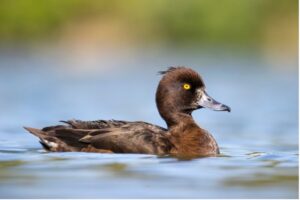
As soon as he arrived, Dan began looking for a tufted duck rumored to be on the Seekonk. Tufted ducks aren’t supposed to be here–they live in Europe and only show up seemingly by accident.
The tufted duck is small and this one, a female, was brown with lighter sides. Her most distinctive trait was a small outcropping of feathers off the back of her head. That tuft is how she gets her name.
Diving Ducks
Tufted ducks are a kind of diving duck. The tufted duck we saw is closely related to the scaups. And, sure enough, it was swimming with a group of scaup.
Scaup are more distinctively marked than tufted ducks. The males in the group had very visible white sides. And even the females, whose coloration was more subdued, had lighter sides that contrasted with their basic brown.
Further north we found a flock of bufflehead. These birds are small, and very active hunters, constantly diving and then flying low to the water to new fishing grounds.
Buffleheads are very closely related to goldeneyes. Even though goldeneyes are closely related to buffleheads, their behavior and appearance are very different. Goldeneyes are bigger and more sedate in both behavior and coloration. While the buffleheads were constantly fishing, the goldeneye never fished while we were watching her.
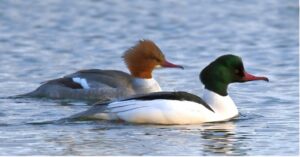
We also saw mergansers. These are large, beautifully colored, and sport a distinctive ruff on the top of their head. They are effective hunters with serrated edges on their bills to grip their prey.
The Dabbling Ducks
Closer to shore we saw mallards, black ducks, and gadwalls, all dabbling ducks. The gadwall, the largest of these ducks, breeds–among other places–along the Saint Lawrence River and through the Great Lakes. It winters further south. In this case, in the Seekonk.
Along the shore there were American black ducks. Black ducks differ from most ducks because both males and females look the same. Both males are dark brown and have slightly lighter-colored heads.
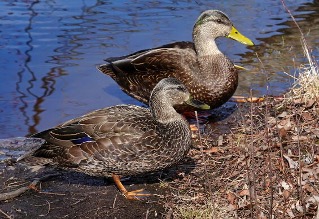
Finally, there is a resident flock of mallard ducks along River Drive. There were black ducks in the mallard flock and at least one hybrid mallard-black duck. Dan explained that these two ducks are not really different species and interbreed whenever they are together, “like different kinds of dogs” one person in the group observed.
These are the ducks we saw on Sunday. What we saw was much more than a list of birds. We saw birds in mixed flocks going about their lives. We learned that there are all kinds of differences in how ducks appear and behave. Just watching them is great pleasure.
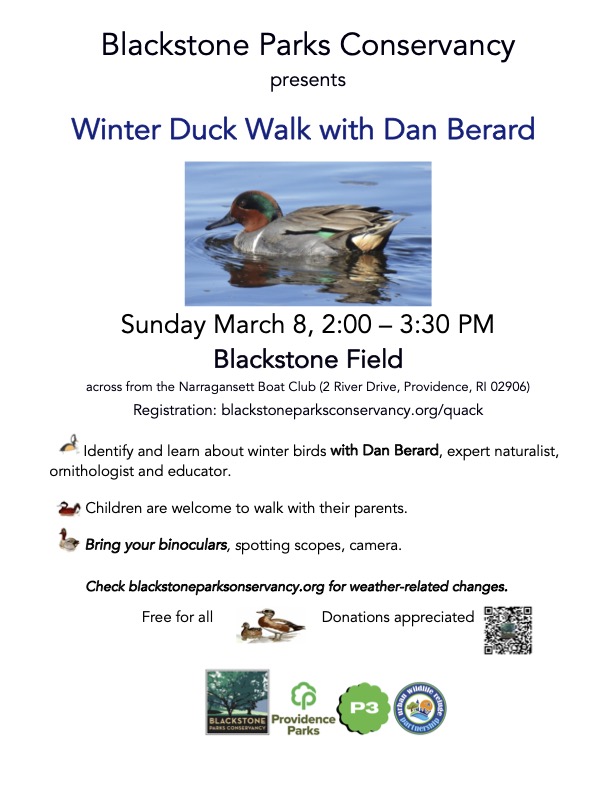
There will be one more winter duck walk, on Sunday, March 8. We’ll meet at 2 PM at Blackstone Field, across from the Narragansett Boat Club (2 River Drive, Providence, RI 02906). We invite you to share the pleasure of watching winter ducks with us. Registration strongly recommended.
Rick Richards
 Kirsten A. Bagaglia, CRPC